



How to actually achieve your goals (the reverse technique)

If you’re reading this, there’s a good chance you don’t know how to set a goal and actually achieve it. Truth is, I was just like you, maybe even worse.
I became more conscious around age 12, when it hit me square in the face that I wanted a better life for myself. But there was no one to look up to. The people around me were living the kind of life I didn’t want, so they weren’t an option.
I didn’t have a phone. I didn’t have YouTube creators to shine a light on possibilities. What I did stumble across though, was the idea of setting goals.
I still remember the year, I was about to turn 13. One Sunday, kids were allowed to sit in the main service instead of being locked away in kiddy class (which I hated anyway). That day, the pastor spoke about New Year’s resolutions, having plans God could help you with, or something along those lines. The way he described it flipped a switch in me.
On the ride home, I pestered my mum with questions. By the time we got back, I skipped lunch, ran straight to my room, and buried myself in creating my first list of goals. I came out excited and convinced this was the start of a whole new me.
I can’t remember exactly what I wrote down but I barely achieved any of it. Within a few weeks, the list was forgotten and I slipped back into old habits.
After failing again and again, I came to a funny conclusion.
Goals don’t work. Maybe the pastor was a con.
I know, I was a kid then, but here’s the scary thing: plenty of adults carry that same belief today. Not because goals don’t work, but because they never learned how to set them in a way that actually makes them achievable.
That’s what we would be dissecting today. What goals actually are, how to set one and how to achieve them with a frame work I discovered works.
My advice is that you go through everything to the end and then take out a pen and book and work through this as a guide to setting your goals because that is what it is.
That said, let’s get into it.
What is a Goal?
A goal is simply where you are headed.
Think of it as your North Star, the vision that, if you reached it, would make your world better.
From my experience, every worthwhile goal fits into three types:
A goal that builds your body.
A goal that builds your mind.
A goal that builds your future.
Almost every human want falls into these buckets.
Nobody wants to stay unhealthy, even people stuck in that state want out.
Almost all of us seek to build our minds: to learn new skills, finish courses, earn degrees, or pick up knowledge that moves us forward.
And of course, we dream of a future: money we want to earn, experiences we want to live, families we want to build, the freedom we want when we retire.
These come naturally, even without much effort.
But here’s the thing: if you don’t have goals or at least a burning desire to improve your life, this entire conversation may not help you.
That problem runs deeper.
But I’ll assume you’re on the other side of that fence.
So here’s the real issue: it isn’t the goals you have. It’s the way you’ve set them.
If your goals only exist in your head, they’re not goals at all, they’re wishes and wishes don’t carry weight.
They don’t push you to act.
A real goal has urgency.
It’s written.
It pulls you forward and won’t let you rest.
And there is an art to setting them.
How To Set A Goal.
The technique that has worked best for me is something not a lot of people talk about.
Before you define your vision, start by creating an Anti-Vision.
Everyone says you should set a clear vision of what you want out of life. That works, but I’ve found that nothing drives you harder than a crystal-clear picture of what you do not want.
Here’s how I discovered this.
When I was younger, I lived in a neighborhood where you could easily see how different families lived. There was a man who came home every night around 9 p.m. His face was always tight with exhaustion. His kids, who were my friends, would joke that they had to “clear the way” whenever he returned because he snapped at the smallest things.
At first, I didn’t think much of it, but as I grew older I realized what that represented: a life defined by endless grind, frustration, and the loss of joy at home.
I remember quietly saying to myself one evening, “I don’t want to end up like that.”
That was my first taste of an Anti-Vision.
You probably have similar pictures in your own world. Maybe it’s an uncle who wasted his potential, or a neighbor who is always bitter, or even a situation at home you never want to repeat in your future. If you take the time to look around you consciously and honestly, you will notice patterns of what you do not want for yourself.
And that is powerful. Because when you recognize the life you dread, it gives you fuel. If you fail to achieve your goals, the risk is not just “staying the same,” it is becoming exactly what you never wanted to be and nobody wants that.
Once you have your Anti-Vision spelled out, then you can define your vision.
That’s when you set your actual goals.
Make your Goals SMART
If your goals don’t meet five specific requirements, they aren’t goals at all, just plain words.
Your goals need to be SMART: Specific, Measurable, Achievable, Relevant, and Timely.
Specific Goals
Specific goals are detailed and concrete.
Saying, I want to be an author someday is vague. Saying, In 10 years, I want to have written and published 3 books is specific. You can even go further by describing how you want to feel when you achieve it, or what that success will look like in your daily life.
The clearer your goal, the more your mind can latch onto it.
Measurable Goals
A goal without a way to measure progress will fade quickly.
Let’s stick with the writing example: if my aim is to write 3 books in 10 years, then I need to publish one every 3 years. That breaks down into writing consistently, ideally every day. Suddenly, the small daily act of writing fuels a long-term vision.
You can track it, you can count it, you can measure it.
Achievable Goals
This one is about honesty.
Your goals need to be possible given your circumstances and effort. That doesn’t mean they should be small. In fact, I believe your goals should scare you a little. They should feel slightly out of reach, because that tension creates growth.
But they should not be outright impossible. A useful rule is this: if your goal fits the other SMART requirements, it is probably achievable.
Relevant Goals
Not every good idea should become a goal.
Earlier, I said every important goal usually falls into one of three categories: a goal that builds your body, mind, or future. If what you’re aiming for doesn’t align with any of these, it may just be a distraction.
Relevance matters because goals require energy, and you don’t want to spend years chasing something that doesn’t meaningfully improve your life.
Timely Goals
A goal without a deadline is just another vague wish.
When you put a time frame on your goal, urgency is born. Deadlines force action. You might achieve your goal before the deadline, or you might fall short, but either way you’ll make significant progress if you’re serious.
Personally, I believe 10 years is the sweet spot. It’s long enough to aim for big things but short enough to keep you from slipping back into old habits.
Once your goals meet all five SMART standards, they shift from vague words to a blueprint you can act on.
But even then, setting goals is only half the journey.
Achieving them requires something more.
How To Achieve A Goal
James Clear once said,
“You do not rise to the level of your goals, you fall to the level of your systems.”
It’s a sentence that sounds profound, and most people nod in agreement, but the question is: how does this actually play out in real life?
The simple translation is this:
Break your goals down into systems.
Think of it like a funnel. At the top, you have your 10-year vision. That filters down into 5 years, then 2 years, then 1 year, then 6 months, then 3 months, then 1 month, and finally, the daily actions you must take today.
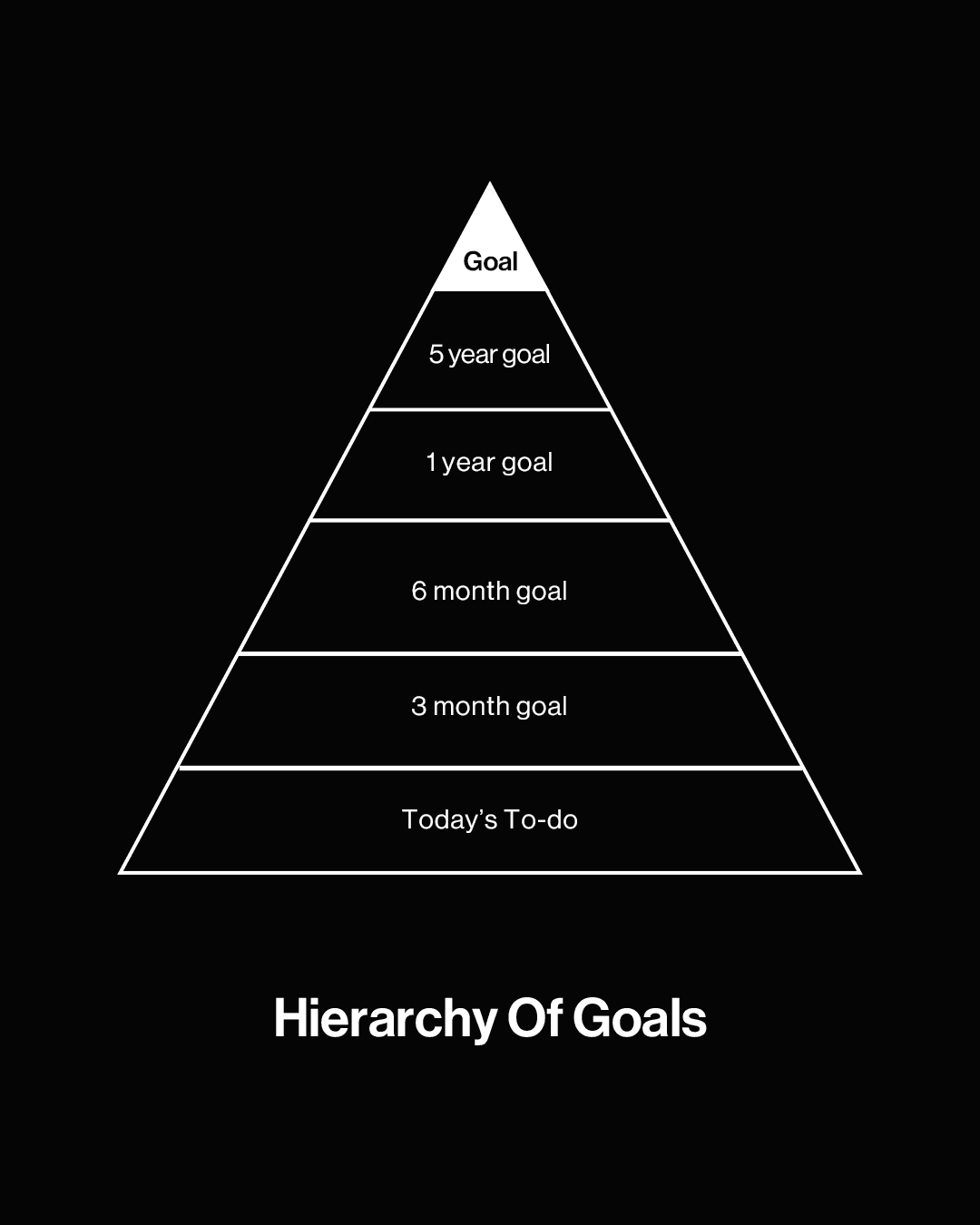
Without breaking your goals down, they remain abstract.
Systems are what make them possible.
Let me give you an example.
Say you want financial abundance in 5 years. You want to live without worrying about bills, payments, or emergencies.
To make it specific, let’s say the goal is a net monthly income of $50,000, and $200,000 in savings and investments.
Now here’s the important step: define who you need to become to achieve this.
How does someone earning $50,000 a month think?
What habits do they keep?
What skills have they mastered?
What are they doing that allows them to capture this much value? For most people, the answer will be running a business or owning assets that create leverage.
The deeper you dig into this, the more obvious it becomes that you’re not there yet. And that’s the point.
So the real question isn’t, How can I have financial abundance in 5 years?
The real question is, How can I become the kind of person who naturally attracts financial abundance within 5 years?
From there, you break it down step by step:
In 5 years, run a successful business generating $50,000 monthly.
In 2 years, be at $20,000 monthly.
In 1 year, build leverage that allows for that level of scale.
In 6 months, acquire skills that create leverage: storytelling, content creation, sales, persuasion, marketing.
In 3 months, read one book on each of these skills to gain foundational knowledge.
In 1 month, decide which business path to pursue.
Today, spend time researching trends and identifying which skills to begin learning.
Notice what’s happening here. A huge, intimidating 5-year goal has been reduced into something you can do today. Research. Read. Practice. Step by step.
This is how systems transform goals from abstract visions into practical steps.
Your goal might not be financial, it could be physical, intellectual, or relational. The exact steps will change, but the principle remains the same: every long-term goal is really a call for self-development today.
If you follow this, you’ll stop falling into the trap of setting resolutions that fade after two weeks. You’ll be living proof that goals do work when you know how to set them, and more importantly, how to achieve them.
But there is one more thing you might struggle with on your path to achieving your goals and it is this. Discipline.
There is also an art to being disciplined, Let us touch on it a little.
Building Discipline
Discipline is a derivative of your identity.
Here’s what I mean.
Take a bodybuilder as an example. Eating junk food or spending the whole day on video games is repulsive why? Because it doesn’t match what he identifies as: a bodybuilder.
On the flip side, someone who does play games all day will find it difficult at first to go to the gym, why? Because that’s a new identity.
So habit change is identity change. Identity change is behavioral change. And discipline toward the right things (whatever you define those to be) often requires you to reshape your identity. That’s why discipline feels tough.
Once you’ve set your goals properly and defined the kind of person you need to become to achieve them, you’ll face friction in the beginning. Why? Because your old identity is clashing with the new one.
From someone who wakes up and checks their phone first…
to someone who wakes up and laces up for a run to hit their health goals.
This is where habits come in. You need to make the new identity automatic. Research suggests it takes an average of 66 days for a new habit to stick. Of course, it depends on the habit and other factors, but that’s the benchmark.
By day 66, discipline in your new pursuit can become second nature. But how do you make it that far? There’s a hack:
Reduce the gap between thought and action.
The longer you sit with a thought, the more your mind spirals out of control. You get the what ifs, doubts, excuses and friction grows. Reducing the time between thinking and doing is how you build discipline.
It can be as simple as:
Planning your day the night before, so you don’t waste energy deciding in the morning what needs doing.
Or Sleeping in your gym clothes, so you hit the gym without giving yourself time to argue.
Or Dropping your phone in another room, so it’s not the first thing you touch when you wake up. (This just came to me as I wrote this—I think I’m going to start doing it myself.)
In his book Atomic Habits, James Clear calls this breaking the cues of your bad habits, disrupt the triggers, and you disrupt the behavior.
That’s it. Now you know how to set goals, how to pursue them, and how to build the discipline needed to stay on course.
This is probably the time to pull out a notebook and work through this from the top as a step by step. Use it as a guide to set goals for yourself, not just once, but every time life demands a new version of you.
Have a lovely weekend.
~ Tolu
PS. I’ve noticed a pattern: no matter where people are in their growth journey, almost everyone is chasing one thing and it is clarity.
Most think clarity is something that just “comes to you.” It isn’t. Clarity has a formula, a mix of shifts, tools, and frames of mind that most people never put together.
That’s why I’m building something called The Clarity Map. It’s a 7-day guide to breaking mental fog and finding focus and it’s designed to give you that sharp sense of direction you’ve been waiting for.
It’ll be live in December, but I’m opening a waitlist. Joining means you’ll get early access, a launch discount, and a few surprises I won’t mention yet.
If clarity has been the missing piece for you, you’ll want to be on that list.